Markets ·
The Rise of South–South Trade
How expanding trade between developing economies is reshaping the geography of global commerce — and why the shift matters for investors looking beyond the traditional North–South framework.
Originally published in May 2024. Updated in October 2026.
For much of the modern era of globalization, international trade was commonly viewed through a North–South lens: advanced economies provided capital, technology and high-value manufactured goods, while developing economies supplied commodities, labour-intensive products and increasingly manufactured exports.
That framework is becoming less representative of how the global economy actually works.
A growing share of international commerce now takes place directly between developing economies — a phenomenon generally described as South–South trade. What began partly as an aspiration for greater economic cooperation among developing countries has evolved into a structural component of global trade.
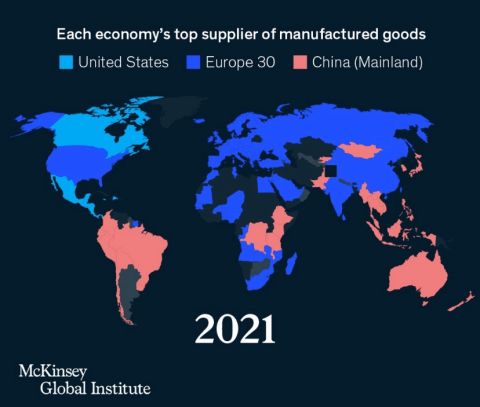
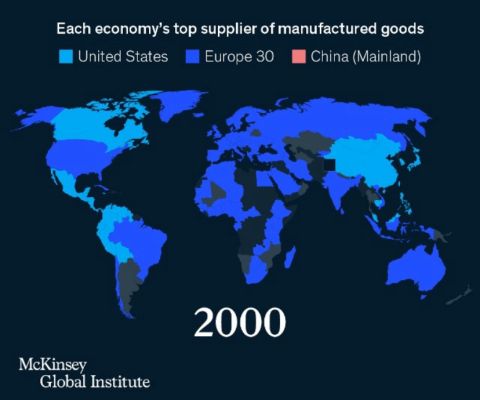
South–South merchandise trade represented around 11% of global merchandise trade in 2000. By 2024, it had risen to approximately 26%, or $6.2 trillion.
From political cooperation to economic integration
The idea of South–South cooperation has roots in the post-war development debate and in efforts by developing and non-aligned countries to gain greater influence over the international economic system.
Institutions such as UNCTAD provided a forum for many of these discussions. But what was once largely a political and developmental concept increasingly has an economic reality behind it.
Developing economies are no longer simply producing for consumers in Europe and North America. Increasingly, they are producing, investing and trading with one another.
China changed the map
The transformation cannot be understood without China.
China’s emergence as a manufacturing powerhouse, commodity importer and major trading partner has created commercial relationships extending throughout Asia, Africa and Latin America.
But South–South trade should not simply be understood as another name for trade with China. The more important long-term question is whether commerce among developing economies becomes broader and more diversified rather than remaining disproportionately centred on a small number of large economies.
A different form of globalization
Greater trade between developing economies matters for several reasons.
First is diversification. Countries able to access multiple export markets can reduce their dependence on demand from any single advanced economy.
Second is the development of regional value chains. Manufacturing does not need to take place entirely within one country: components, raw materials, processing and final assembly can be distributed across economies with different comparative advantages.
Third is the transfer of capital, technology and knowledge. South–South economic integration extends beyond merchandise exports. Investment and business relationships can help emerging economies develop industrial capabilities of their own.
And finally, there is demographics. Many developing economies combine younger populations, urbanisation and rising consumption. As domestic markets grow, trade between them can increasingly be driven by their own final demand rather than exclusively by demand from developed economies.
The Global South is not one market
There is a danger in treating South–South trade as an automatically positive or homogeneous phenomenon.
The economic structures of India, Brazil, Indonesia, Vietnam, Nigeria and China are radically different, and trade integration remains uneven. Developing East Asia alone accounts for around 60% of exports from developing economies, while Africa and Latin America remain substantially less integrated regionally.
Greater South–South trade therefore does not automatically mean greater resilience. What matters is what countries trade, how diversified their partners are, and whether trade contributes to the development of higher-value domestic industries.
An investment perspective
This is ultimately what makes South–South trade interesting to me from an investment perspective.
Emerging markets should not be viewed simply as a collection of economies expected to “catch up” with developed markets. Their relationships with one another are changing too.
China’s industrial expansion, India’s growth, manufacturing development across Southeast Asia, commodity flows from Latin America and Africa, and the emergence of new consumer markets are gradually creating a more complex network of economic relationships.
That does not imply the disappearance of the United States or Europe from global trade. Developed economies remain enormously important.
Instead, the more interesting development is the emergence of a more multipolar commercial system.
For investors looking at emerging markets, understanding those connections may become just as important as analysing the relationship between each individual country and the developed world.
Author’s note — October 2026
I originally wrote about South–South trade in May 2024. Subsequent data have reinforced the underlying trend. UNCTAD reports that South–South merchandise trade reached $6.2 trillion in 2024, representing 26% of world merchandise trade compared with 11% at the beginning of the century.
Sources
Personal opinion based solely on public information. Not investment advice and not an offer or recommendation. Views are my own and not those of my employer. Full disclaimer.