Markets ·
Emerging Markets as Engines of Global Growth
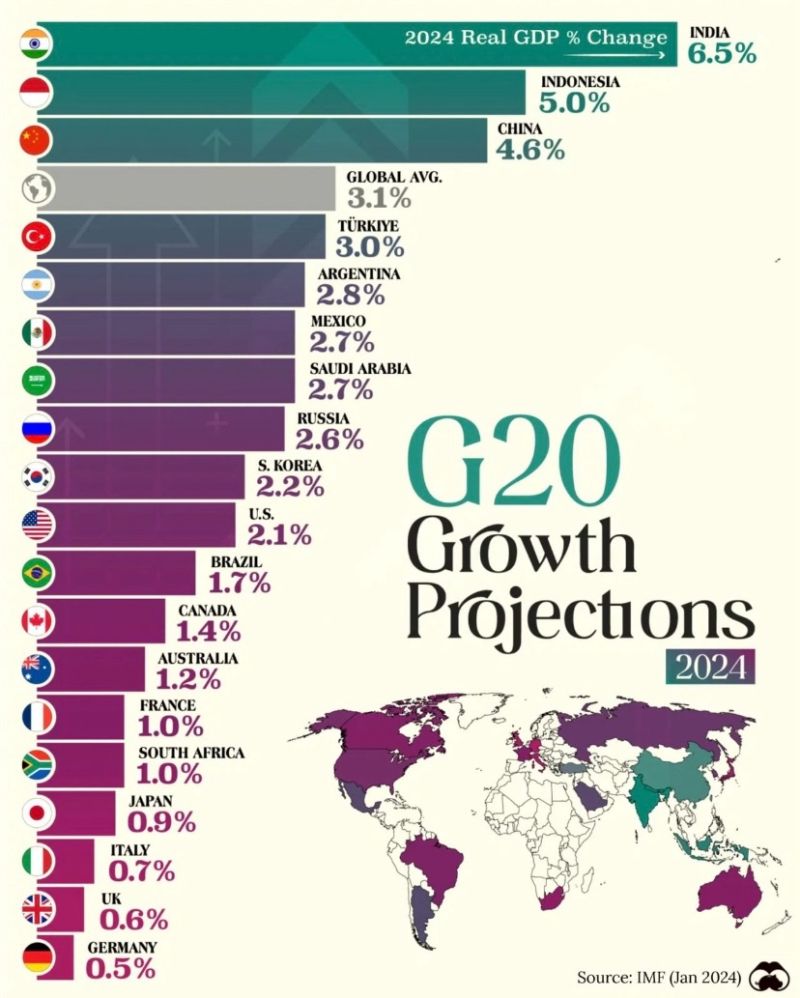
In early 2024, IMF forecasts highlighted a striking growth gap between several large emerging economies and the global average. The more durable question is what turns rapid GDP expansion into long-term, investable growth.
Originally published in February 2024. Expanded in October 2026.
At the beginning of 2024, the IMF projected global economic growth of 3.1% for the year. Several major emerging economies were expected to expand considerably faster: India at 6.5%, Indonesia at 5.0% and China at 4.6%.
Those numbers illustrated a broader theme that remains relevant beyond any single forecast: a substantial part of incremental global economic activity is increasingly linked to emerging and developing economies.
But a high GDP growth rate is only the beginning of an investment thesis.
The growth gap
The IMF’s January 2024 outlook expected emerging market and developing economies collectively to grow by 4.1%. Emerging and Developing Asia stood out further, with projected growth of 5.2%.
The dispersion mattered as much as the aggregate number. “Emerging markets” is a convenient label, but it combines economies at radically different stages of development, with different demographics, institutions, industrial structures and sources of growth.
Growth is not the same as returns
The intuitive argument is simple: faster-growing economies should offer better investment opportunities. In practice, the relationship is much less direct.
Economic growth can create favourable conditions for companies, but investment returns also depend on valuation, profitability, capital allocation, governance, currency movements and the price an investor pays for future growth.
A rapidly expanding economy can still produce disappointing asset returns if expectations were already excessive. Conversely, slower-growing markets can contain exceptional companies or attractive securities.
Three different growth stories
The economies I highlighted in the original post illustrate why emerging markets should not be analysed as a single allocation.
India combined strong domestic demand with favourable demographics and an expanding services and manufacturing base.
Indonesia offered a different combination: a young population, natural resources, industrialisation and a large domestic consumer market.
China, meanwhile, was already undergoing a transition. A 4.6% growth forecast was high relative to most developed economies, but represented a significant slowdown compared with China’s historical trajectory.
The headline growth rates therefore concealed fundamentally different investment cases.
Where structural growth comes from
For long-term investors, the more useful question is what sits underneath GDP growth.
Several forces can matter: population and urbanisation, productivity, capital formation, infrastructure, education, technological adoption and integration into global supply chains.
This connects directly with two other themes I have written about. Demographic expansion can enlarge labour forces and consumer markets, but only when economies convert population growth into productive employment and rising incomes.
Likewise, the expansion of South–South trade can give developing economies additional markets, investment relationships and regional value chains beyond the traditional North–South model.
Looking beyond traditional borders
My original 2024 post argued that investors should look beyond traditional developed-market boundaries. I would frame that argument more carefully today.
The case for emerging markets is not simply that they grow faster. It is that many of the world’s most important long-term transformations — demographic change, urbanisation, industrialisation, digital adoption and new trade relationships — are taking place disproportionately within them.
That creates opportunity, but also complexity. Political risk, currency volatility, governance, liquidity and uneven institutional development can all materially affect returns.
An investment perspective
The most useful way to think about emerging markets may be to abandon the idea that they represent one coherent asset class economically.
India is not China. Indonesia is not Brazil. Vietnam is not South Africa.
Each market reflects a different combination of demographics, institutions, industry, capital flows and valuation.
The growth forecasts that originally prompted this note were interesting because they showed where economic momentum was concentrated in early 2024. The deeper investment question is whether that momentum can translate into sustainable corporate earnings, productive capital formation and returns that compensate investors for the risks they assume.
That is the distinction between identifying economic growth and identifying an investment opportunity.
Author’s note — October 2026
This article expands on a short post I published in February 2024 using the IMF’s January 2024 forecasts. The figures above are intentionally presented as the forecasts available at that time rather than as current growth estimates. The purpose of revisiting the piece is not to rewrite the historical call with hindsight, but to develop the investment question behind it.
Sources
Personal opinion based solely on public information. Not investment advice and not an offer or recommendation. Views are my own and not those of my employer. Full disclaimer.