Markets ·
Demographics and the Rebalancing of Global Growth
Population growth is becoming increasingly concentrated in developing economies. The divergence between a rapidly growing Africa, an ageing Europe and a still-dominant Asia could reshape consumption, labour markets and the geography of long-term investment.
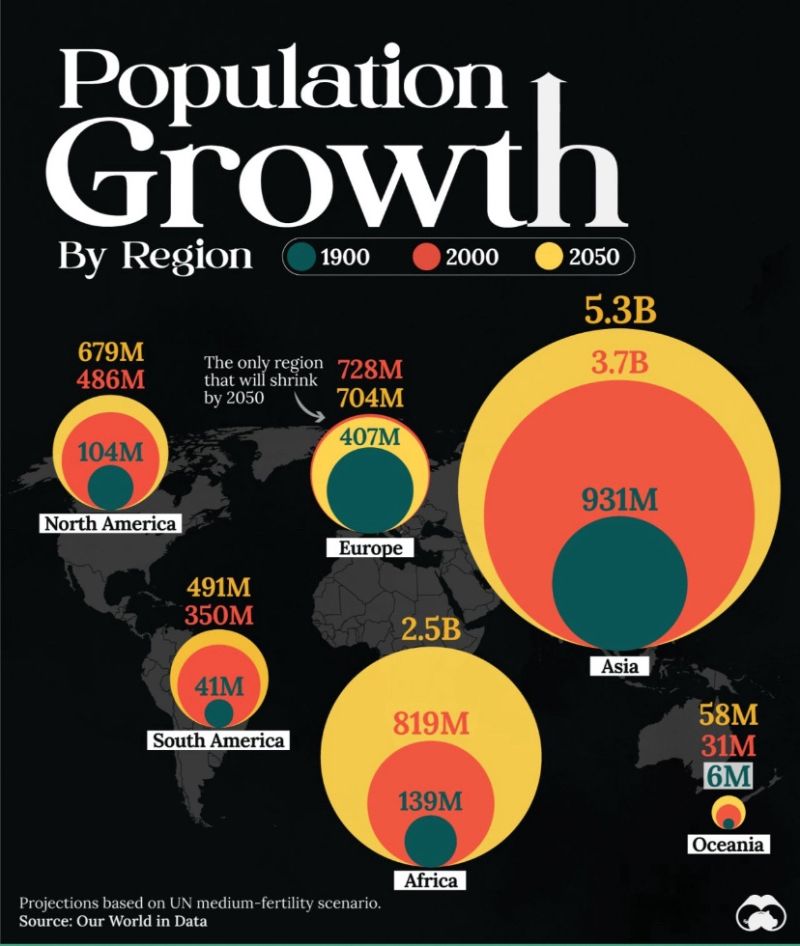
Originally published in March 2024. Expanded and updated in October 2026.
Demographics move slowly, but their economic consequences can be profound.
When I first shared a population projection in 2024, three contrasts stood out: Europe was moving toward demographic contraction, Africa was expanding rapidly, and Asia was set to remain the world’s demographic centre of gravity.
Updated United Nations data reinforce the broader direction of that observation. In 2025, five out of every six people lived in developing economies. By 2050, that proportion is expected to approach six in seven. Africa’s share of the global population is projected to rise from roughly 19% to 26%, while developed economies increasingly face ageing populations and, in many cases, stagnation or decline.
These are not simply demographic statistics. Over time, they can influence where labour is available, where consumption grows, where infrastructure is needed and where capital may find new opportunities.
Europe: ageing becomes an economic variable
Europe’s demographic challenge is not merely slower population growth.
It is also the changing age structure of the population. As fertility declines and people live longer, the relative weight of older cohorts increases. This can affect labour-force growth, public finances, pension systems and the composition of consumption.
UNCTAD estimates that the dependency ratio in developed economies is already rising and could reach roughly 72 dependants for every 100 working-age people by 2050.
Demography does not determine economic performance by itself. Productivity, migration, technology and policy can offset part of the effect. But ageing changes the starting point from which those economies grow.
Africa: scale, youth and execution
Africa sits on the opposite side of the demographic transition.
The continent remains the world’s fastest-growing region demographically. Most of the world’s population increase over the coming decades is expected to occur in developing economies, with Africa accounting for a particularly large share.
That creates an intuitive investment narrative: more people, expanding cities, a larger labour force and potentially much larger consumer markets.
But population growth is potential, not a guarantee of prosperity.
For a demographic dividend to translate into sustainable economic growth, economies need productive employment, education, infrastructure, access to electricity and capital, functioning institutions and deeper regional markets.
The distinction matters. A rapidly expanding working-age population can become an extraordinary economic asset when workers are productively employed. Without sufficient investment and job creation, the same demographic pressure can instead intensify unemployment, migration and fiscal stress.
Asia remains the centre of gravity
Africa’s growth does not mean Asia becomes less important.
Asia remains by far the world’s most populous region and combines demographic scale with several of the largest and fastest-developing consumer and industrial economies.
The more interesting change is therefore not a simple shift from Asia to Africa, but the increasing concentration of global population in developing economies more broadly.
India, Southeast Asia and other parts of developing Asia may continue to combine large domestic markets with manufacturing expansion, urbanisation and rising incomes, even as some East Asian economies begin to confront ageing themselves.
The demographic picture within emerging markets is therefore increasingly diverse.
Population is not GDP
One of the easiest mistakes in long-term investing is to treat demographic growth as an investment thesis on its own.
A larger population can support a larger economy, but GDP per capita, productivity, institutions and capital formation ultimately determine how much economic value that population creates.
The same applies to consumer markets. Hundreds of millions of additional inhabitants do not automatically translate into hundreds of millions of consumers with meaningful purchasing power.
This is why demographics are better viewed as a structural variable rather than a forecast of investment returns.
They tell us where economic pressure and potential demand may emerge. They do not tell us which companies, countries or assets will capture that opportunity.
An investment perspective
For me, the most interesting implication is the gradual rebalancing of the world’s economic map.
A larger share of humanity will live in economies that are today classified as developing. At the same time, many advanced economies will need to adapt to slower labour-force growth and greater old-age dependency.
That divergence can influence several long-duration investment themes: urban infrastructure, housing, energy, financial services, healthcare, education, logistics and consumer markets.
It may also reinforce the importance of the theme I discussed separately in my work on South–South trade. As developing economies represent a greater share of the world’s population and demand, their economic relationships with one another become increasingly important.
The investment question is therefore not simply where will the population grow?
It is which economies will successfully convert demographic change into productivity, incomes and investable growth?
Author’s note — October 2026
This article expands on a short observation I published in March 2024 alongside a population projection. The original post highlighted three trends — demographic contraction in Europe, rapid expansion in Africa and Asia’s continued scale. Updated UN data continue to support that broad direction, while also making the central caveat clearer: demographic growth creates economic potential, but institutions, productivity and investment determine how much of that potential is realised.
Sources
Personal opinion based solely on public information. Not investment advice and not an offer or recommendation. Views are my own and not those of my employer. Full disclaimer.