Venture Capital ·
From Startups to Scaleups: Italy's Venture Capital Challenge
A day with founders and investors at OGR Torino reinforced a broader question about Italian venture capital: the ecosystem can create ambitious startups, but can it provide the capital, networks and conditions required to scale them?
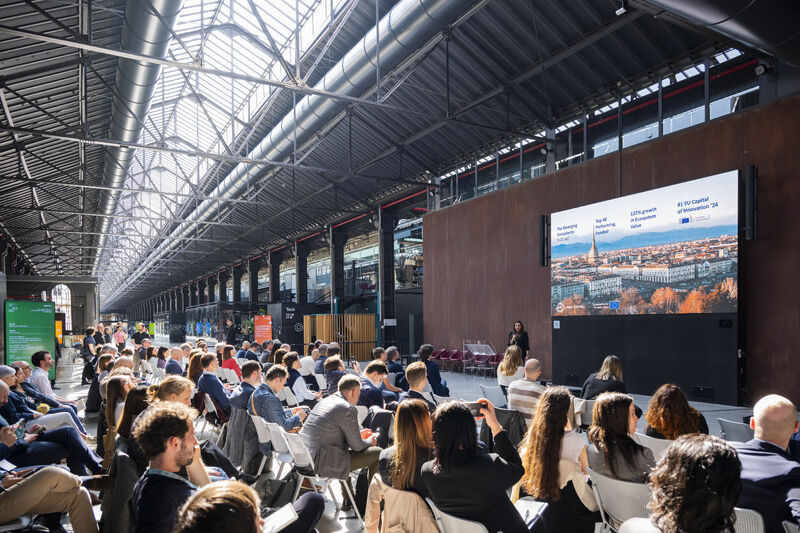
Originally inspired by the “50 in a Day” event at OGR Torino in March 2025. Expanded in October 2026.
In March 2025, I attended 50 in a Day at OGR Torino, an opportunity to meet founders and other participants in the Italian innovation ecosystem.
The event itself was valuable for the conversations. The broader question it left me with was more structural: what does Italy need to turn a growing startup ecosystem into a repeatable scaleup ecosystem?
The ecosystem is maturing
Italy’s venture market has developed significantly from a relatively small base. More founders are building technology companies, specialist funds have emerged and international investors are paying greater attention to selected Italian businesses.
By late 2025, Italian Tech Alliance and Growth Capital described a market in which Series A activity remained relatively healthy and international participation was increasing.
But maturation is not the same as completion.
Their Q3 2025 analysis identified Series B as one of the most difficult turning points in the Italian startup growth path. Only six Series B rounds had been recorded year-to-date at that point.
That gap matters because creating startups and scaling startups require different capital markets.
The scaleup problem
Seed capital can help a company prove that a product and market exist.
Series A can finance early commercial expansion.
Beyond that point, the requirements change. Companies may need tens or hundreds of millions of euros, international hiring, senior management, new geographies and investors capable of supporting several subsequent rounds.
If domestic growth capital is scarce, successful companies face a choice: raise from international investors, relocate parts of the business, sell earlier than planned or grow more slowly.
International capital is therefore not a weakness. It can be an important part of the solution.
The challenge is ensuring that Europe creates an environment in which globally competitive companies can continue building substantial operations here.
Italy inside Europe
Italy’s venture-capital challenge is part of a broader European one.
Europe has strong universities, industrial expertise, scientific research and entrepreneurial talent. Yet the transition from technical innovation to globally scaled company remains uneven.
For Italy, there are specific advantages worth building around: advanced manufacturing, industrial automation, aerospace and space technology, life sciences, energy, design and sectors where software meets traditional industrial expertise.
These areas do not require Italy to reproduce Silicon Valley.
They require an ecosystem that can finance companies built around Italy’s own comparative advantages.
Capital is only one ingredient
More venture funding alone will not create better companies.
Scaling also depends on experienced operators, founder ambition, employee equity incentives, access to international customers, efficient regulation and a market for exits.
This is why startup events matter when they work well. Their value is not the event itself; it is the density of relationships they can create between founders, investors, corporates and talent.
Venture capital is fundamentally a network business.
What I took from Torino
My experience in venture investing had already shown me that an investment is rarely just a financial model.
Early-stage companies are shaped disproportionately by people, execution and access to the right relationships.
Being at OGR Torino reinforced that point from the ecosystem side.
A country can have excellent founders and investors individually. The real advantage appears when those participants form a network capable of repeatedly connecting ideas with capital, talent and customers.
An investment perspective
I do not think the interesting question is whether Italy can produce startups. It clearly can.
The more important question is whether the ecosystem can systematically turn the best of those startups into European and global category leaders.
That requires stronger growth-stage financing, international capital and a willingness to build on sectors where Italy and Europe already possess genuine technical or industrial depth.
The next stage of Italian venture capital is therefore less about proving that entrepreneurship exists.
It is about building the infrastructure that allows ambition to scale.
Sources
Personal opinion based solely on public information. Not investment advice and not an offer or recommendation. Views are my own and not those of my employer. Full disclaimer.